
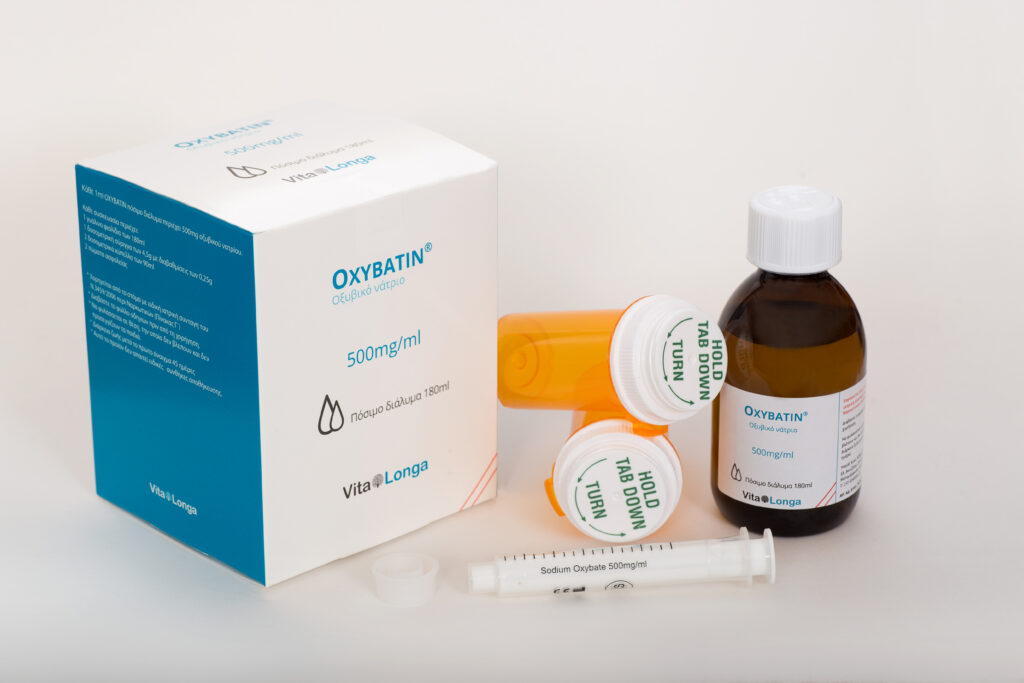
Oxybatin®
Sodium Oxybate Oral Solution 500mg/ml
BT X 1 BOTTLE (PET) X 180ML + 1 GRADUATED DOSING SYRINGE (PP) + 2 DOSING CUPS (PP)
General
Oxybatin® contains the active substance sodium oxybate. Oxybatin® acts by stabilising nocturnal sleep, although its exact mechanism of action is not known.
Indications
Treatment of narcolepsy with cataplexy in adult patients, adolescents and children from 7 years of age.
Posology and Method of Administration
Treatment initiation and continuation should be under the guidance of a physician experienced in the treatment of narcolepsy. Physicians should strictly observe the contraindications, warnings and precautions.
Dosage:
Adults
The recommended starting dose of sodium oxybate is 4.5g daily divided into two equal doses of 2.25g. The dose should be titrated on the basis of efficacy and tolerability (see section 4.4) up to a maximum of 9g per day, divided into two equal doses of 4.5g per dose, adjusting up or down in increments of 1.5g per day (i.e. 0.75g per dose). A minimum interval of one to two weeks is recommended before each stepwise dose change. The dose of 9g daily must not be exceeded, because of the possible occurrence of serious symptoms at doses of 18g per day or greater (see section 4.4).
Doses of 4.5g are administered only if the patient has previously been titrated to this dose level.
Discontinuation of Oxybatin
The effects of discontinuing sodium oxybate have not been systematically evaluated in controlled clinical trials.
If the patient stops taking the medicinal product for more than 14 consecutive days, titration must be restarted from the lowest dose.
Special Populations:
Elderly
Elderly patients should be closely monitored for impairment of motor and/or cognitive function when taking sodium oxybate.
Hepatic Impairment
The starting dose should be halved in all patients with hepatic impairment and the response to each stepwise dose increase should be carefully monitored.
Renal Impairment
All patients with impaired renal function should take into account the recommendation to reduce sodium intake.
Paediatric Population
Adolescents and children from 7 years of age with a minimum body weight of 15 kg:
Oxybatin is administered orally twice at night. Dosing recommendations are provided in the table below:
Patient Weight Starting total daily dose (taken in 2 divided doses)* Titration regimen (until clinical effect) Recommended maximum total daily dose 15kg – <20kg ≤ 1g/day ≤ 0.5g/day/week 0.2g/kg/day 20kg – <30kg ≤ 2g/day ≤ 1g/day/week 0.2g/kg/day 30kg – <45kg ≤ 3g/day ≤ 1g/day/week 0.2g/kg/day ≥45kg ≤ 4.5g/day ≤ 1.5g/day/week 9g/day Undesirable Effects
Summary of the safety profile
Clinical Studies
The safety profile was qualitatively the same in adult and paediatric studies.
In adults, the most frequently reported adverse reactions are dizziness, nausea and headache, all of which occur in 10% to 20% of patients. The most serious adverse reactions are suicide attempt, psychosis, respiratory depression and convulsions.
In adults, the safety and efficacy of sodium oxybate for the management of narcolepsy symptoms were established in four multicentre, randomised, double-blind, placebo-controlled, parallel-group studies in patients with narcolepsy with cataplexy, except for one study in which patients were not required to have narcolepsy in order to be enrolled. Two Phase 3 and one Phase 2, double-blind, parallel-group, placebo-controlled studies were conducted to evaluate the indication of sodium oxybate for fibromyalgia in adults. In addition, randomised, double-blind, placebo-controlled, crossover drug interaction studies were conducted with ibuprofen, diclofenac and valproate in healthy subjects.
Post-marketing experience
In addition to the adverse reactions reported during clinical studies, adverse reactions have been reported during post-marketing experience. It is not always possible to reliably estimate their frequency in the population to be treated.
Tabulated list of adverse reactions
Adverse reactions are listed by System Organ Class according to the MedDRA database.
Frequency estimation: very common (≥ 1/10), common (≥ 1/100 to < 1/10), uncommon (≥ 1/1,000 to < 1/100), rare (≥ 1/10,000 to < 1/1,000), very rare (< 1/10,000), not known (frequency cannot be estimated from the available data).
Within each frequency category, adverse reactions are presented in order of decreasing seriousness.
Infections and infestations
Common: nasopharyngitis, vaginitis
Immune system disorders
Uncommon: hypersensitivity
Metabolism and nutrition disorders
Common: anorexia, decreased appetite
Frequency not known: dehydration, increased appetite
Psychiatric disorders
Common: depression, cataplexy, anxiety, abnormal dreams, abnormal thinking, confusional state, disorientation, nightmares, sleepwalking, sleep disorder, insomnia, middle insomnia, nervousness.
Uncommon: suicide attempt, psychosis, paranoia, hallucinations, abnormal thinking, agitation, initial insomnia
Frequency not known: suicidal ideation, homicidal ideation, aggression, euphoric mood, sleep-related eating disorder, panic attack, mania / bipolar disorder, delusion, bruxism, irritability and increased libido
Nervous system disorders
Very common: dizziness, headache
Common: sleep paralysis, somnolence, tremor, balance disorder, disturbance in attention, hypoaesthesia, paraesthesia, sedation, dysgeusia.
Uncommon: myoclonus, amnesia, restless legs syndrome
Frequency not known: convulsions, loss of consciousness, dyskinesia
Eye disorders
Common: blurred vision
Ear and labyrinth disorders
Common: vertigo
Frequency not known: tinnitus
Cardiac disorders
Common: palpitations
Vascular disorders
Common: hypertension
Respiratory, thoracic and mediastinal disorders
Common: dyspnoea, snoring, nasal congestion
Frequency not known: respiratory depression, sleep apnoea
Gastrointestinal disorders
Very common: nausea (the frequency of nausea is higher in women than in men)
Common: vomiting, diarrhoea, upper abdominal pain
Uncommon: faecal incontinence
Frequency not known: dry mouth
Skin and subcutaneous tissue disorders
Common: hyperhidrosis, rash
Frequency not known: urticaria, angioedema, seborrhoea.
Musculoskeletal and connective tissue disorders
Common: arthralgia, muscle spasms, back pain
Renal and urinary disorders
Common: nocturnal enuresis, urinary incontinence
Frequency not known: pollakiuria / urgency, nocturia
General disorders and administration site conditions
Common: asthenia, fatigue, feeling drunk, peripheral oedema
Investigations
Common: blood pressure increased, weight decreased
Injury, poisoning and procedural complications
Common: fall
Description of selected adverse reactions
In some patients, a relapse of cataplexy is observed with greater frequency upon discontinuation of sodium oxybate treatment; however, the greater frequency may be due to the usual fluctuations of the disease. Although the experience from clinical trials of sodium oxybate in patients with narcolepsy/cataplexy at therapeutic doses does not clearly demonstrate the induction of a withdrawal syndrome, in rare cases adverse reactions such as insomnia, headache, anxiety, dizziness, sleep disorders, somnolence, hallucinations and psychotic disorders have been observed following discontinuation of GHB.
Special Populations
Paediatric Population
In the paediatric population, the efficacy and safety of sodium oxybate for the treatment of narcolepsy with symptoms of cataplexy were established in a phase 2/3 double-blind, placebo-controlled, multicentre, randomised-withdrawal study.
In a study in children and adolescents the most frequently reported related adverse reactions were enuresis (18.3%), nausea (12.5%), vomiting (8.7%) and weight decreased (8.7%), decreased appetite (6.7%), headache (5.8%), dizziness (5.8%). Adverse reactions of suicidal ideation (1%) and acute psychosis (1%) were also reported. (see section 4.4 and section 6).
In some children between 7 and < 18 years of age, post-marketing surveillance showed that sodium oxybate was discontinued because of abnormal behaviour, aggression and mood change.
SmPC
Find the full SmPC of Oxybatin® here
Additional Links
Warning:
The above information is provided for informational or educational purposes. The initiation, continuation and discontinuation of treatment with Oxybatin® should be done strictly and only under the direction of a physician.
The links provided on this website that lead to external websites of international organisations, regulatory authorities and other bodies are for informational purposes only.
Vita Longa does not maintain any commercial, financial or other cooperation with the specific organisations, unless expressly stated. Reference or referral to them does not imply endorsement, sponsorship or recommendation of the views, information or services provided on the respective websites.
Vita Longa is not responsible for the content, accuracy or updating of the information hosted on external websites.


