
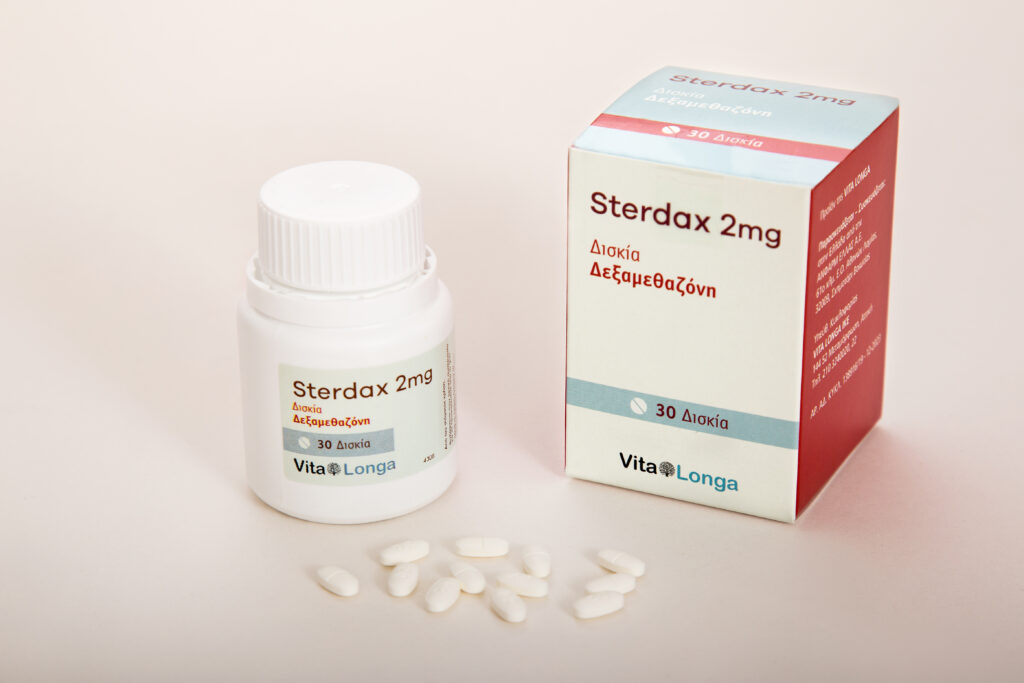
Sterdax®
Dexamethasone tablets 2mg
BT X 1 BOTTLE(HDPE) X 30 TABS
General Information
Sterdax® is a medicinal product containing as its active substance dexamethasone, a synthetic corticosteroid with potent anti-inflammatory and immunosuppressive action.
Dexamethasone belongs to the class of glucocorticoids, substances that mimic the action of cortisol, a natural hormone produced by the adrenal glands. It acts mainly through activation of intracellular glucocorticoid receptors. It is characterised by high anti-inflammatory potency and relatively little sodium retention.
Indications
Dexamethasone is a corticosteroid. It is intended for use in some endocrine and non-endocrine disorders, in some cases of cerebral oedema and for diagnostic testing of adrenocortical hyperfunction.
STERDAX tablets are indicated for the treatment of coronavirus disease 2019 (COVID-19) in adult and adolescent patients (aged 12 years and older with body weight of at least 40 kg) who require supplemental oxygen therapy.
Endocrine disorders: Exophthalmos of endocrine origin.
Diagnostic purposes: The newer synthetic derivatives (dexamethasone) are used. The low-dose dexamethasone suppression test is useful for the diagnosis of Cushing’s syndrome and for clarifying the underlying cause.
Non-endocrine disorders: Dexamethasone may be used in the treatment of non-endocrine conditions responsive to corticosteroids, including:
Allergy and anaphylaxis: Anaphylaxis.
Arteritis, collagenosis: Polymyalgia rheumatica, polyarteritis nodosa.
Haematological disorders: Haemolytic anaemia (also autoimmune), leukaemia, myeloma, idiopathic thrombocytopenic purpura in adults, reticulolymphoproliferative disorders (see also the section on oncological disorders).
Gastrointestinal disorders: For treatment during the acute phase of the following: ulcerative colitis (rectal type only), regional enteritis (Crohn’s disease), some forms of hepatitis.
Muscular disorders: Polymyositis.
Neurological disorders: Raised intracranial pressure secondary to brain tumours, acute exacerbations of multiple sclerosis.
Ophthalmological disorders: Anterior and posterior uveitis, optic neuritis, chorioretinitis, iridocyclitis, temporal arteritis, orbital pseudotumour.
Renal disorders: Nephrotic syndrome.
Pulmonary disorders: Chronic bronchial asthma, aspiration pneumonitis, chronic obstructive pulmonary disease (COPD), sarcoidosis, allergic lung disease such as farmer’s lung and pigeon breeder’s lung, Löffler’s syndrome, cryptogenic fibrosing alveolitis.
Rheumatic disorders: Some cases or special forms (Felty’s syndrome, Sjögren’s syndrome) of rheumatoid arthritis, including juvenile rheumatoid arthritis, acute rheumatism, systemic lupus erythematosus, temporal arteritis (polymyalgia rheumatica).
Skin disorders: Pemphigus vulgaris, bullous pemphigus, erythrodermas, severe forms of erythema multiforme (Stevens-Johnson syndrome), mycosis fungoides, dermatitis herpetiformis bullosa.
Infections: Tuberculous meningitis with a high protein level in the cerebrospinal fluid, septic shock from Gram-negative bacteria.
Oncological disorders: Lymphatic leukaemia, particularly of the acute form, malignant lymphoma (Hodgkin’s disease, Non-Hodgkin lymphoma), metastatic breast cancer, hypercalcaemia as a result of bone metastasis or Kahler’s disease.
Miscellaneous: Severe allergic reactions, as an immunosuppressant in organ transplantation, as an adjunct in the prevention of nausea and vomiting and in the treatment of cancer with oncolytic agents that have a severe emetic effect.
Posology and Method of Administration
Dosage
Adults
General considerations:
The dose must be titrated based on the individual response of each person and the nature of the disease. In order to minimise adverse reactions, the lowest possible effective dose should be used (see “Adverse reactions”).
The initial dose ranges from 0.5-10 mg per day depending on the disease being treated. In more severe diseases, doses greater than 10 mg may be required. The initial dose should be maintained or adjusted until the patient’s response is satisfactory. Both the evening dose, which is useful for relieving morning stiffness, and the divided-dose regimen are associated with greater suppression of the “hypothalamic-pituitary-adrenal” axis. If there is no satisfactory clinical response within a reasonable period of time, discontinue treatment with dexamethasone and give the patient other treatment.
If the initial response is satisfactory, the maintenance dose should be determined by gradually reducing the dose to the lowest required to maintain an adequate clinical response. Chronic dosing should preferably not exceed 2 mg of dexamethasone daily.
Patients should be monitored for any signs requiring dose adjustment. These may be changes in clinical condition as a result of relapses or exacerbations of the disease, individual response to the medicine and the effect of stress (e.g. surgery, infection, trauma). During stressful situations, a temporary increase in dose may be necessary.
If the medicine must be stopped after more than a few days of treatment, discontinuation should be gradual.
The following equivalences facilitate the transition to dexamethasone from other glucocorticoids:
Comparing quantities milligram for milligram (mg), dexamethasone is approximately equivalent to betamethasone, 4 to 6 times more potent than methylprednisolone and triamcinolone, 6 to 8 times more potent than prednisone and prednisolone, 25 to 30 times more potent than hydrocortisone and approximately 35 times more potent than cortisone.
Acute, self-limiting allergic disorders or acute exacerbations of chronic allergic disorders
The following dosage regimen is suggested, combining parenteral and oral treatment:
Day 1: Intramuscular injection of Dexamethasone, 4 mg or 8 mg Day 2: Two dexamethasone 0.5 mg tablets twice a day Day 3: Two dexamethasone 0.5 mg tablets twice a day Day 4: One dexamethasone 0.5 mg tablet twice a day Day 5: One dexamethasone 0.5 mg tablet twice a day Day 6: One dexamethasone 0.5 mg tablet Day 7: One dexamethasone 0.5 mg tablet Day 8: Reassessment This schedule is designed to ensure adequate treatment during acute episodes while minimising the risk of overdose in chronic cases.
Raised intracranial pressure:
Initial treatment is usually by injection. When maintenance treatment is required, this should be changed to dexamethasone tablets as soon as possible. For the palliative management of patients with recurrent or inoperable brain tumours, the maintenance dose must be calculated individually for each person. A dose of 2 mg two or three times a day may be effective. The smallest dose necessary to control symptoms should always be used.
Dexamethasone suppression tests:
Tests for Cushing’s syndrome:
2 mg (1 tablet) of Sterdax® should be given at 11 p.m. Blood samples are then taken at 8 a.m. the next morning for determination of plasma cortisol. For determination of 17-hydroxycorticosteroid excretion, a 24-hour urine collection should be used.
If greater accuracy is required, 500 micrograms (1 tablet) of Sterdax® should be given every 6 hours for 48 hours. Blood should be taken at 8 a.m. on the third morning for determination of plasma cortisol.
Test to distinguish Cushing’s syndrome caused by excess pituitary ACTH from the syndrome caused by other causes:
2 mg (1 tablet) of Sterdax® should be given every 6 hours for 48 hours. Blood should be taken at 8 a.m. on the third morning for determination of plasma cortisol. For determination of 17-hydroxycorticosteroid excretion, a 24-hour urine collection should be used.
For the treatment of Covid-19 disease:
In adult patients 6 mg orally, once a day for up to 10 days.
Adverse Reactions
The frequency of the expected adverse reactions, such as suppression of the “hypothalamic-pituitary-adrenal” axis, is related to the relative potency of the active substance, the dose, the time of administration and the duration of treatment. During short-term treatment that follows the dosage recommendations and with regular monitoring of patients, the
risk of adverse reactions is small. The following adverse reactions have been reported with the following frequency:
System/organ class Frequency Adverse reactions Infections and infestations Not known Increased susceptibility to infections or exacerbation of (latent) infections with suppression of clinical symptoms, opportunistic infections, reactivation of latent tuberculosis, exacerbation of eye infections, candidiasis. Blood and lymphatic system disorders Not known Leukocytosis, lymphopenia, eosinopenia, polycythaemia. Immune system disorders Not known Hypersensitivity reactions including anaphylaxis, immunosuppression (see also “Infections and infestations”). Endocrine disorders Not known Suppression of the “hypothalamic-pituitary-adrenal” axis and induction of Cushing’s syndrome (typical symptoms: moon face, erythraemia, truncal obesity), secondary adrenocortical and pituitary insufficiency (particularly in stressful situations, such as trauma or surgery). Metabolism and nutrition disorders Not known Weight gain, negative protein and calcium balance, increased appetite, sodium and fluid retention, potassium loss (caution: rhythm disturbances), hypokalaemic alkalosis, manifestation of latent diabetes mellitus, decreased carbohydrate tolerance with increased requirement for antidiabetic treatment, hypercholesterolaemia, hypertriglyceridaemia. Psychiatric disorders Not known Psychological dependence, depression, insomnia, aggravation of schizophrenia, mental disorders ranging from euphoria to the manifestation of psychosis. Nervous system disorders Not known Increased intracranial pressure with papilloedema in children (cerebral pseudotumour – Pseudotumor cerebri) usually after discontinuation of treatment, manifestation of latent epilepsy, increased seizures in epilepsy. Eye disorders Not known Increased intraocular pressure, glaucoma, papilloedema, cataract mainly with posterior subcapsular opacity, atrophy of the cornea and sclera, increased ocular viral, fungal and bacterial infections, worsening of symptoms associated with corneal ulcers, chorioretinopathy, blurred vision. Cardiac disorders Not known Rupture of the heart muscle following a recent history of myocardial infarction, congestive heart failure in predisposed patients. Vascular disorders Not known Hypertension, vasculitis, increased atherosclerosis and risk of thrombosis/thromboembolism. Respiratory, thoracic and mediastinal disorders Not known Hiccups Gastrointestinal disorders Not known Dyspepsia, gastric ulcer with perforation and haemorrhage, acute pancreatitis, ulcerative oesophagitis, flatulence, nausea, vomiting. Skin and subcutaneous tissue disorders Not known Hirsutism, hypertrichosis, skin atrophy, telangiectasia, striae, erythema, steroid acne, petechiae, ecchymosis, allergic dermatitis, urticaria, angioneurotic oedema, thinning of scalp hair, pigmentation disorders, increased capillary fragility, perioral dermatitis. Musculoskeletal and connective tissue disorders Not known Growth inhibition in infants, children and adolescents, premature epiphyseal closure, osteoporosis, vertebral and long bone fractures, aseptic necrosis of the femoral and humeral heads, tendon rupture, proximal myopathy, muscle weakness, loss of muscle mass. Reproductive system and breast disorders Not known Menstrual irregularities, amenorrhoea, impotence. General disorders and administration site conditions Not known Delayed wound healing, malaise, steroid withdrawal syndrome: a very rapid reduction in the dose of corticosteroids after prolonged treatment may lead to acute adrenal insufficiency, hypotension and death. A “withdrawal syndrome” may occur with fever, myalgia, arthralgia, rhinitis, conjunctivitis, painful itchy skin nodules and weight loss. Injury, poisoning and procedural complications Not known Reduced response to vaccination and skin tests, tendency to bruise. SmPC
Find the full SmPC of Sterdax ® here
Additional Links
Warning:
The information above is provided for informational or educational purposes. Treatment with Sterdax® should be initiated, continued, and discontinued strictly and only under a doctor’s supervision.
The links provided on this website that lead to external websites of international organizations, regulatory authorities, and other entities are for informational purposes only.
Vita Longa has no commercial, financial, or other affiliation with these organizations, unless explicitly stated. Any mention or reference to them does not imply endorsement, sponsorship, or recommendation of the views, information, or services provided on the respective websites.
Vita Longa assumes no responsibility for the content, accuracy or updating of the information hosted on external websites.


