
CortiCare®
Food Supplement
Information
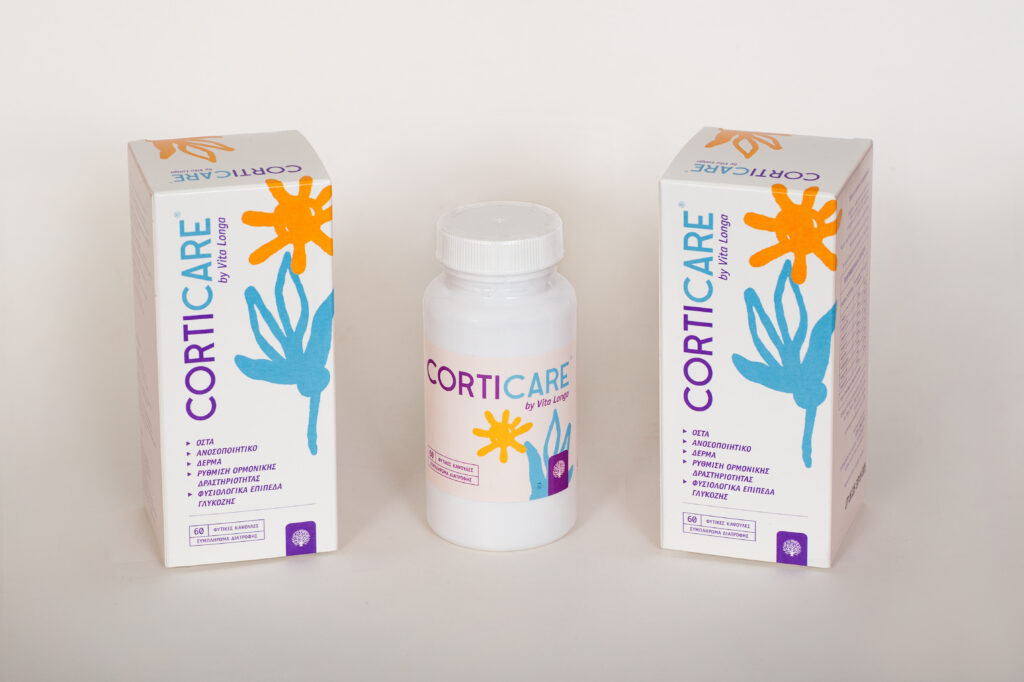
CortiCare® is a dietary supplement containing selected vitamins and minerals, specially formulated to support the nutritional needs of people undergoing long-term treatment with corticosteroids.
CortiCare® contains the following nutrients:
- Vitamins A, C, D3, K2, B6
- Magnesium (Mg)
- Zinc (Zn)
- Chromium (Cr)
The formulation of CortiCare® is based on a combination of vitamins and trace elements that work synergistically to support key physiological functions of the body.
Its ingredients, in accordance with European Regulation 432/2012, have the following effects:
- Vitamin D, K2 and Zinc: contribute to the maintenance of normal bones
- Vitamins C, D, A and B6: contribute to the normal function of the immune system
- Vitamin A and Zinc: contribute to the maintenance of normal skin
- Vitamin B6: contributes to the regulation of hormonal activity
- Chromium: contributes to the maintenance of normal blood glucose level
INFORMATION TABLE
Active Ingedients
Per Daily Dose (2 capsules)
%RDI*
Chromium
200 μg 500% Vitamin D3
40 μg 800%
Vitamin C
200 mg 250%
Vitamin Α 800 μg 100%
Magnesium
100 mg 27% Zinc
10 mg 100%
Vitamin Β6 6 mg 429%
Vitamin Κ2
100 μg 133%
*RDI = Recommended Daily Intake
It is available as hard, transparent capsules in a white plastic bottle containing 60 vegetable capsules.
The recommended dose is 1 capsule with a glass of water before a meal, twice daily, or as directed by your doctor.
Warning: Dietary supplements should not be used as a substitute for a balanced diet. This product is not intended for the prevention, treatment or cure of any human disease. Consult your doctor if you are pregnant, breastfeeding, under 18 years of age, taking medication or have any health conditions, before consuming this product
It must be used in accordance with the instructions for use. If you are taking other medicines at the same time, it is advisable to seek advice from a healthcare professional.Information Leaflet
Find the enclosed information leaflet here
Frequently Asked Questions (FAQ)
What does CortiCare contain and what are the functions of its ingedients?
CortiCare contains carefully selected vitamins and minerals and takes a holistic approach, with its ingredients working together to support various bodily functions.
Composition:
- Vitamins: A, B6, C, D3, K2
- Minerals: Magnesium (Mg), Zinc (Zn), Chromium (Cr)
Ingredients’ Function:
- Vit D,Vit K, Magnesium (Mg), Zinc (Zn): maintenance of normal bones
- Vit C, Vit A,Vit B6, Zinc (Zn): normal function of the immune system
- Vit A, Zinc (Zn): maintenance of normal skin
- Vit B6: regulation of hormonal activity
- Chromium (Cr): maintenance of normal blood glucose level
What makes CortiCare stand out?
- CortiCare is a dietary supplement that simultaneously supports bone health, the immune system, skin, hormonal balance, and glucose metabolism.
- It is the only dietary supplement that contains these specific ingredients in these amounts, thus providing an all-in-one solution.
- The combination of vitamins and minerals is designed so that the ingredients work synergistically with one another.
It meets the body’s multiple daily needs through a single formula.
How are the effects of the ingredients at these specific quantities documented?
- The effects of CortiCare’s ingredients are substantiated in accordance with European Regulation 432/2012, which establishes the approved health claims for vitamins and minerals in the European Union.
- The amounts of the ingredients have been carefully selected to provide the benefits for which these specific vitamins and minerals are known.
- At the same time, the documentation is based on extensive scientific literature and recognized studies concerning the role of vitamins and minerals in the human body.
- Below you will find detailed bibliographic references presenting the scientific data supporting the action of each ingredient.
Where is CortiCare manufactured, and how is it tested?
- CortiCare is a dietary supplement for which a notification has been submitted to the National Organization for Medicines (EOF).
- It is manufactured in Greece at a certified facility in accordance with strict quality and safety standards.
- Its formulation was developed by the pharmaceutical company Vita Longa, which has extensive experience in the distribution of pharmaceutical products.
- The entire production process, as well as the certificates for the raw materials, have been submitted to EOF as part of the notification.
Bibliography
Curtis, J. R., Westfall, A. O., Allison, J., Bijlsma, J. W., Freeman, A., George, V., Kovac, S. H., Spettell, C. M., & Saag, K. G. (2006). Population‐based assessment of adverse events associated with long‐term glucocorticoid use. Arthritis Care & Research, 55(3), 420–426. https://doi.org/10.1002/art.21984
Fardet, L., Kassar, A., Cabane, J., & Flahault, A. (2007). Corticosteroid-Induced adverse events in adults. Drug Safety, 30(10), 861–881. https://doi.org/10.2165/00002018-200730100-00005
Van Staa, T. P., Van Staa, T. P., Van Staa, T. P., Leufkens, H. G. M., & Cooper, C. (2002). The Epidemiology of Corticosteroid-Induced Osteoporosis: a Meta-analysis. Osteoporosis International, 13(10), 777–787. https://doi.org/10.1007/s001980200108
Weinstein, R. S. (2012). Glucocorticoid-Induced osteoporosis and osteonecrosis. Endocrinology and Metabolism Clinics of North America, 41(3), 595–611. https://doi.org/10.1016/j.ecl.2012.04.004
Yasir M, Goyal A, Sonthalia S. Corticosteroid Adverse Effects. 2023 Jul 3. In: StatPearls [Internet]. Treasure Island (FL): StatPearls Publishing; 2025 Jan–. PMID: 30285357.
Meyler’s Side Effects of Drugs (Sixteenth Edition)
The International Encyclopedia of Adverse Drug Reactions and Interactions
2016, Pages 594-657, ISBN: 978-0-444-53716-4
Huang, Z., Liu, Y., Qi, G., Brand, D., & Zheng, S. (2018). Role of vitamin A in the immune system. Journal of Clinical Medicine, 7(9), 258. https://doi.org/10.3390/jcm7090258
Michalak, M., Pierzak, M., Kręcisz, B., & Suliga, E. (2021). Bioactive Compounds for skin Health: A review. Nutrients, 13(1), 203. https://doi.org/10.3390/nu13010203
Polcz, M. E., & Barbul, A. (2019). The role of vitamin A in wound healing. Nutrition in Clinical Practice, 34(5), 695–700. https://doi.org/10.1002/ncp.10376
Roche, F. C., & Harris-Tryon, T. A. (2021). Illuminating the role of Vitamin A in skin innate immunity and the skin microbiome: a narrative review. Nutrients, 13(2), 302. https://doi.org/10.3390/nu13020302
VanBuren, C. A., & Everts, H. B. (2022). Vitamin A in Skin and hair: An update. Nutrients, 14(14), 2952. https://doi.org/10.3390/nu14142952
Chang, H., Tzen, J. T. C., Lin, S., Wu, Y., & Chiang, E. I. (2010). Long-Term prednisolone treatments increase bioactive vitamin B6Synthesis in vivo. Journal of Pharmacology and Experimental Therapeutics, 337(1), 102–109. https://doi.org/10.1124/jpet.110.174839
Chiang, E., Smith, D. E., Selhub, J., Dallal, G., Wang, Y., & Roubenoff, R. (2005). Inflammation causes tissue-specific depletion of vitamin B6. Arthritis Research & Therapy, 7(6). https://doi.org/10.1186/ar1821
Djokic, G., Vojvodić, P., Korcok, D., Agic, A., Rankovic, A., Djordjevic, V., Vojvodic, A., Vlaskovic-Jovicevic, T., Peric-Hajzler, Z., Matovic, D., Vojvodic, J., Sijan, G., Wollina, U., Tirant, M., Van Thuong, N., Fioranelli, M., & Lotti, T. (2019). The effects of magnesium – melatonin – Vit B complex supplementation in treatment of insomnia. Open Access Macedonian Journal of Medical Sciences, 7(18), 3101–3105. https://doi.org/10.3889/oamjms.2019.771
Jankowska, M., Trzonkowski, P., Dębska-Ślizień, A., Marszałł, M., & Rutkowski, B. (2014). Vitamin B6 status, immune response and inflammation markers in kidney transplant recipients treated with polyclonal anti-thymocyte globulin. Transplantation Proceedings, 46(8), 2631–2635. https://doi.org/10.1016/j.transproceed.2014.08.009
Morris, M. S., Sakakeeny, L., Jacques, P. F., Picciano, M. F., & Selhub, J. (2009). Vitamin B-6 intake is inversely related to, and the requirement is affected by, inflammation status. Journal of Nutrition, 140(1), 103–110. https://doi.org/10.3945/jn.109.114397
Schellack, N., Yotsombut, K., Sabet, A., Nafach, J., Hiew, F. L., & Kulkantrakorn, K. (2025). Expert Consensus on Vitamin B6 therapeutic use for patients: Guidance on safe dosage, duration and clinical management. Drug Healthcare and Patient Safety, Volume 17, 97–108. https://doi.org/10.2147/dhps.s499941
Carr, A., & Maggini, S. (2017). Vitamin C and immune function. Nutrients, 9(11), 1211. https://doi.org/10.3390/nu9111211
Chow, O., & Barbul, A. (2013). Immunonutrition: role in wound healing and tissue regeneration. Advances in Wound Care, 3(1), 46–53. https://doi.org/10.1089/wound.2012.0415
Hemilä, H. (2004). Vitamin C Supplementation and Respiratory Infections: a Systematic Review. Military Medicine, 169(11), 920–925. https://doi.org/10.7205/milmed.169.11.920
Han, A., Park, Y., Lee, Y., Park, S. Y., & Park, C. Y. (2022). Position Statement: Vitamin D intake to prevent osteoporosis and fracture in adults. Journal of Bone Metabolism, 29(4), 205–215. https://doi.org/10.11005/jbm.2022.29.4.205
Kazemian, E., Pourali, A., Sedaghat, F., Karimi, M., Basirat, V., Hezaveh, Z. S., Davoodi, S. H., & Holick, M. F. (2022). Effect of supplemental vitamin D3 on bone mineral density: a systematic review and meta-analysis. Nutrition Reviews, 81(5), 511–530. https://doi.org/10.1093/nutrit/nuac068
Lei, S., Zhang, X., Song, L., Wen, J., Zhang, Z., Tian, J., Yang, R., Xu, S., Qiu, S., MacIsaac, R. J., Aleksova, J., Mac-Way, F., Dupuis, M., Benaiges, D., Mauricio, D., Sommer, A. P., Barzilay, J. I., Gallagher, J. C., Pan, L., . . . Liu, G. (2025). Expert consensus on vitamin D in osteoporosis. Annals of Joint, 10, 1. https://doi.org/10.21037/aoj-24-48
Nakamura, K., & Iki, M. (2006). Efficacy of optimization of vitamin D in preventing osteoporosis and osteoporotic fractures: A systematic review. Environmental Health and Preventive Medicine, 11(4), 155–170. https://doi.org/10.1007/bf02905274
Voulgaridou, G., Papadopoulou, S. K., Detopoulou, P., Tsoumana, D., Giaginis, C., Kondyli, F. S., Lymperaki, E., & Pritsa, A. (2023). Vitamin D and Calcium in Osteoporosis, and the Role of Bone Turnover Markers: A Narrative Review of Recent Data from RCTs. Diseases, 11(1), 29. https://doi.org/10.3390/diseases11010029
Akbulut, A. C., Pavlic, A., Petsophonsakul, P., Halder, M., Maresz, K., Kramann, R., & Schurgers, L. (2020). Vitamin K2 Needs an RDI Separate from Vitamin K1. Nutrients, 12(6), 1852. https://doi.org/10.3390/nu12061852
Giri, T. K., Newton, D., Chaudhary, O., Deych, E., Napoli, N., Villareal, R., Diemer, K., Milligan, P. E., & Gage, B. F. (2019). Maximal dose-response of vitamin-K2 (menaquinone-4) on undercarboxylated osteocalcin in women with osteoporosis. International Journal for Vitamin and Nutrition Research, 90(1–2), 42–48. https://doi.org/10.1024/0300-9831/a000554
Knapen, M. H. J., Drummen, N. E., Smit, E., Vermeer, C., & Theuwissen, E. (2013). Three-year low-dose menaquinone-7 supplementation helps decrease bone loss in healthy postmenopausal women. Osteoporosis International, 24(9), 2499–2507. https://doi.org/10.1007/s00198-013-2325-6
Rodríguez, C. R., & Curiel, M. D. (2019). Vitamin K and bone health: A review on the effects of Vitamin K deficiency and supplementation and the effect of Non-Vitamin K antagonist oral anticoagulants on different bone parameters. Journal of Osteoporosis, 2019, 1–8. https://doi.org/10.1155/2019/2069176
Sato, T., Inaba, N., & Yamashita, T. (2020). MK-7 and its effects on bone quality and strength. Nutrients, 12(4), 965. https://doi.org/10.3390/nu12040965
Schurgers, L. J., Teunissen, K. J. F., HamulyáK, K., Knapen, M. H. J., Vik, H., & Vermeer, C. (2006). Vitamin K–containing dietary supplements: comparison of synthetic vitamin K1 and natto-derived menaquinone-7. Blood, 109(8), 3279–3283. https://doi.org/10.1182/blood-2006-08-040709
Violi, F., Lip, G. Y., Pignatelli, P., & Pastori, D. (2016). Interaction between dietary vitamin K intake and anticoagulation by vitamin K antagonists. Medicine, 95(10), e2895. https://doi.org/10.1097/md.0000000000002895
Castiglioni, S., Cazzaniga, A., Albisetti, W., & Maier, J. (2013). Magnesium and Osteoporosis: Current State of Knowledge and future research Directions. Nutrients, 5(8), 3022–3033. https://doi.org/10.3390/nu5083022
Djokic, G., Vojvodić, P., Korcok, D., Agic, A., Rankovic, A., Djordjevic, V., Vojvodic, A., Vlaskovic-Jovicevic, T., Peric-Hajzler, Z., Matovic, D., Vojvodic, J., Sijan, G., Wollina, U., Tirant, M., Van Thuong, N., Fioranelli, M., & Lotti, T. (2019). The effects of magnesium – melatonin – Vit B complex supplementation in treatment of insomnia. Open Access Macedonian Journal of Medical Sciences, 7(18), 3101–3105. https://doi.org/10.3889/oamjms.2019.771
Groenendijk, I., Van Delft, M., Versloot, P., Van Loon, L. J., & De Groot, L. C. (2021). Impact of magnesium on bone health in older adults: A systematic review and meta-analysis. Bone, 154, 116233. https://doi.org/10.1016/j.bone.2021.116233
Razzaque, M. S. (2018). Magnesium: Are we consuming enough? Nutrients, 10(12), 1863. https://doi.org/10.3390/nu10121863
Rondanelli, M., Faliva, M. A., Tartara, A., Gasparri, C., Perna, S., Infantino, V., Riva, A., Petrangolini, G., & Peroni, G. (2021). An update on magnesium and bone health. BioMetals, 34(4), 715–736. https://doi.org/10.1007/s10534-021-00305-0
Chow, O., & Barbul, A. (2013). Immunonutrition: role in wound healing and tissue regeneration. Advances in Wound Care, 3(1), 46–53. https://doi.org/10.1089/wound.2012.0415
Medicine, I. O. (2001). Dietary reference intakes for vitamin A, vitamin K, arsenic, boron, chromium, copper, iodine, iron, manganese, molybdenum, nickel, silicon, vanadium, and zinc. In National Academies Press eBooks. https://doi.org/10.17226/10026
Michalak, M., Pierzak, M., Kręcisz, B., & Suliga, E. (2021). Bioactive Compounds for skin Health: A review. Nutrients, 13(1), 203. https://doi.org/10.3390/nu13010203
Cefalu, W. T., & Hu, F. B. (2004). Role of chromium in human health and in diabetes. Diabetes Care, 27(11), 2741–2751. https://doi.org/10.2337/diacare.27.11.2741
Kooshki, F., Tutunchi, H., Vajdi, M., Karimi, A., Niazkar, H. R., Shoorei, H., & Gargari, B. P. (2021). A Comprehensive insight into the effect of chromium supplementation on oxidative stress indices in diabetes mellitus: A systematic review. Clinical and Experimental Pharmacology and Physiology, 48(3), 291–309. https://doi.org/10.1111/1440-1681.13462
Ravina, A., Slezak, L., Mirsky, N., Bryden, N. A., & Anderson, R. A. (1999). Reversal of corticosteroid‐induced diabetes mellitis with supplemental chromium. Diabetic Medicine, 16(2), 164–167. https://doi.org/10.1046/j.1464-5491.1999.00004.x


