
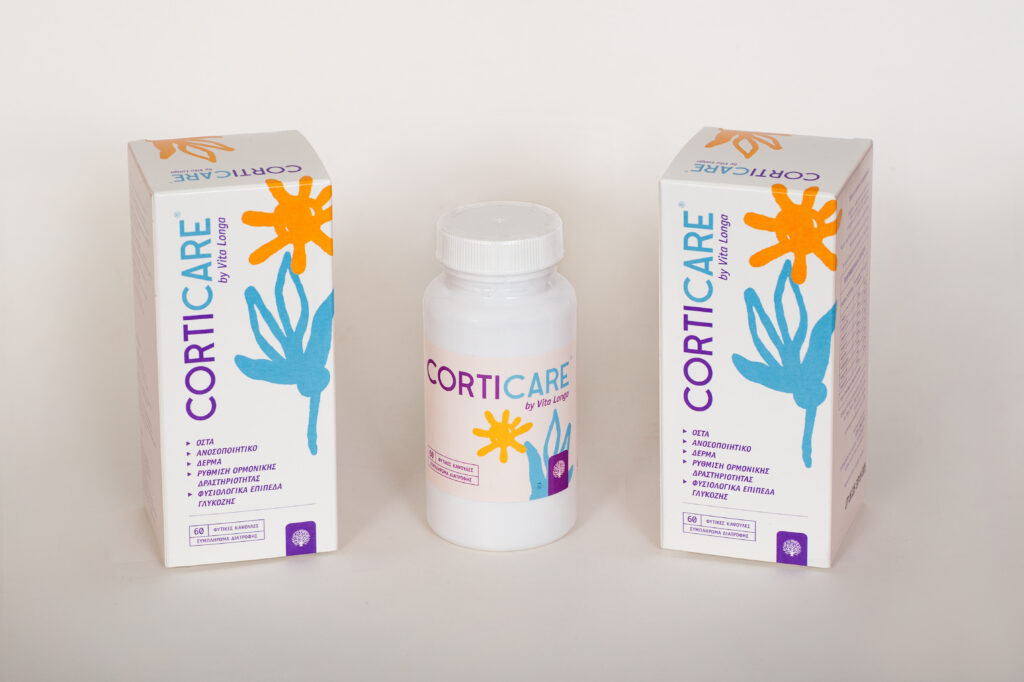
CortiCare®
Συμπλήρωμα διατροφής
Πληροφορίες
Το CortiCare® είναι συμπλήρωμα διατροφής που περιέχει επιλεγμένες βιταμίνες και ανόργανα στοιχεία, ειδικά σχεδιασμένο να υποστηρίζει τις διατροφικές ανάγκες ατόμων που λαμβάνουν θεραπεία με κορτικοστεροειδή για παρατεταμένα χρονικά διαστήματα.
Το CortiCare® περιέχει τα ακόλουθα θρεπτικά συστατικά:
- Βιταμίνες A, C, D3, K2, B6
- Μαγνήσιο (Mg)
- Ψευδάργυρο (Zn)
- Χρώμιο (Cr)
Η σύνθεση του CortiCare® βασίζεται σε ένα συνδυασμό βιταμινών και ιχνοστοιχείων που λειτουργούν συνεργικά για να υποστηρίξουν βασικές φυσιολογικές λειτουργίες του οργανισμού.
Τα συστατικά του, σύμφωνα με τον Ευρωπαϊκό Κανονισμό 432/2012, δρουν ως εξής:
- Βιταμίνες D3 και K2, ψευδάργυρος: συμβάλλουν στη διατήρηση της φυσιολογικής κατάστασης των οστών.
- Βιταμίνες C, D, A και B6: συμβάλλουν στη φυσιολογική λειτουργία του ανοσοποιητικού συστήματος.
- Βιταμίνη A και ψευδάργυρος: συμβάλλουν στη διατήρηση της φυσιολογικής κατάστασης του δέρματος.
- Βιταμίνη B6: συμβάλλει στη ρύθμιση της ορμονικής δραστηριότητας.
- Χρώμιο: συμβάλλει στη διατήρηση των φυσιολογικών επιπέδων γλυκόζης στο αίμα.
ΠΛΗΡΟΦΟΡΙΑΚΑ ΣΤΟΙΧΕΙΑ Ενεργά συστατικά Ανά ημερήσια δόση (2 κάψουλες)
%ΣΗΠ* Χρώμιο 200 μg 500% Βιταμίνη D3 40 μg 800% Βιταμίνη C 200 mg 250% Βιταμίνη Α 800 μg 100% Μαγνήσιο 100 mg 27% Ψευδάργυρος 10 mg 100% Βιταμίνη Β6 6 mg 429% Βιταμίνη Κ2 100 μg 133% *ΣΗΠ = Συνιστώμενη Ημερήσια Ποσότητα Διατίθεται σε μορφή σκληρής διάφανης κάψουλας σε λευκή πλαστική φιάλη που περιέχει 60 φυτικές κάψουλες.
Η συνιστώμενη δοσολογία είναι 1 κάψουλα με ένα ποτήρι νερό πριν το γεύμα, δύο φορές ημερησίως ή σύμφωνα με τις οδηγίες του γιατρού σας.
Προειδοποίηση: Τα συμπληρώματα διατροφής δεν πρέπει να χρησιμοποιούνται ως υποκατάστατο μιας ισορροπημένης δίαιτας. Το προϊόν αυτό δεν προορίζεται για την πρόληψη, αγωγή ή θεραπεία ανθρώπινης νόσου. Συμβουλευτείτε το γιατρό σας εάν είστε έγκυος, θηλάζουσα, κάτω των 18 ετών, αν βρίσκεστε υπό φαρμακευτική αγωγή ή αντιμετωπίζετε προβλήματα υγείας, πριν καταναλώσετε το προϊόν
Η χρήση του πρέπει να γίνεται σύμφωνα με τις οδηγίες χρήσης. Σε περίπτωση ταυτόχρονης φαρμακευτικής αγωγής, συνιστάται η συμβουλή επαγγελματία υγείας.Ενημερωτικό Έντυπο
Θα βρείτε το εσώκλειστο ενημερωτικό έντυπο του CortiCare® εδώ
Βιβλιογραφία
Curtis, J. R., Westfall, A. O., Allison, J., Bijlsma, J. W., Freeman, A., George, V., Kovac, S. H., Spettell, C. M., & Saag, K. G. (2006). Population‐based assessment of adverse events associated with long‐term glucocorticoid use. Arthritis Care & Research, 55(3), 420–426. https://doi.org/10.1002/art.21984
Fardet, L., Kassar, A., Cabane, J., & Flahault, A. (2007). Corticosteroid-Induced adverse events in adults. Drug Safety, 30(10), 861–881. https://doi.org/10.2165/00002018-200730100-00005
Van Staa, T. P., Van Staa, T. P., Van Staa, T. P., Leufkens, H. G. M., & Cooper, C. (2002). The Epidemiology of Corticosteroid-Induced Osteoporosis: a Meta-analysis. Osteoporosis International, 13(10), 777–787. https://doi.org/10.1007/s001980200108
Weinstein, R. S. (2012). Glucocorticoid-Induced osteoporosis and osteonecrosis. Endocrinology and Metabolism Clinics of North America, 41(3), 595–611. https://doi.org/10.1016/j.ecl.2012.04.004
Yasir M, Goyal A, Sonthalia S. Corticosteroid Adverse Effects. 2023 Jul 3. In: StatPearls [Internet]. Treasure Island (FL): StatPearls Publishing; 2025 Jan–. PMID: 30285357.
Meyler’s Side Effects of Drugs (Sixteenth Edition)
The International Encyclopedia of Adverse Drug Reactions and Interactions
2016, Pages 594-657, ISBN: 978-0-444-53716-4
Huang, Z., Liu, Y., Qi, G., Brand, D., & Zheng, S. (2018). Role of vitamin A in the immune system. Journal of Clinical Medicine, 7(9), 258. https://doi.org/10.3390/jcm7090258
Michalak, M., Pierzak, M., Kręcisz, B., & Suliga, E. (2021). Bioactive Compounds for skin Health: A review. Nutrients, 13(1), 203. https://doi.org/10.3390/nu13010203
Polcz, M. E., & Barbul, A. (2019). The role of vitamin A in wound healing. Nutrition in Clinical Practice, 34(5), 695–700. https://doi.org/10.1002/ncp.10376
Roche, F. C., & Harris-Tryon, T. A. (2021). Illuminating the role of Vitamin A in skin innate immunity and the skin microbiome: a narrative review. Nutrients, 13(2), 302. https://doi.org/10.3390/nu13020302
VanBuren, C. A., & Everts, H. B. (2022). Vitamin A in Skin and hair: An update. Nutrients, 14(14), 2952. https://doi.org/10.3390/nu14142952
Chang, H., Tzen, J. T. C., Lin, S., Wu, Y., & Chiang, E. I. (2010). Long-Term prednisolone treatments increase bioactive vitamin B6Synthesis in vivo. Journal of Pharmacology and Experimental Therapeutics, 337(1), 102–109. https://doi.org/10.1124/jpet.110.174839
Chiang, E., Smith, D. E., Selhub, J., Dallal, G., Wang, Y., & Roubenoff, R. (2005). Inflammation causes tissue-specific depletion of vitamin B6. Arthritis Research & Therapy, 7(6). https://doi.org/10.1186/ar1821
Djokic, G., Vojvodić, P., Korcok, D., Agic, A., Rankovic, A., Djordjevic, V., Vojvodic, A., Vlaskovic-Jovicevic, T., Peric-Hajzler, Z., Matovic, D., Vojvodic, J., Sijan, G., Wollina, U., Tirant, M., Van Thuong, N., Fioranelli, M., & Lotti, T. (2019). The effects of magnesium – melatonin – Vit B complex supplementation in treatment of insomnia. Open Access Macedonian Journal of Medical Sciences, 7(18), 3101–3105. https://doi.org/10.3889/oamjms.2019.771
Jankowska, M., Trzonkowski, P., Dębska-Ślizień, A., Marszałł, M., & Rutkowski, B. (2014). Vitamin B6 status, immune response and inflammation markers in kidney transplant recipients treated with polyclonal anti-thymocyte globulin. Transplantation Proceedings, 46(8), 2631–2635. https://doi.org/10.1016/j.transproceed.2014.08.009
Morris, M. S., Sakakeeny, L., Jacques, P. F., Picciano, M. F., & Selhub, J. (2009). Vitamin B-6 intake is inversely related to, and the requirement is affected by, inflammation status. Journal of Nutrition, 140(1), 103–110. https://doi.org/10.3945/jn.109.114397
Schellack, N., Yotsombut, K., Sabet, A., Nafach, J., Hiew, F. L., & Kulkantrakorn, K. (2025). Expert Consensus on Vitamin B6 therapeutic use for patients: Guidance on safe dosage, duration and clinical management. Drug Healthcare and Patient Safety, Volume 17, 97–108. https://doi.org/10.2147/dhps.s499941
Carr, A., & Maggini, S. (2017). Vitamin C and immune function. Nutrients, 9(11), 1211. https://doi.org/10.3390/nu9111211
Chow, O., & Barbul, A. (2013). Immunonutrition: role in wound healing and tissue regeneration. Advances in Wound Care, 3(1), 46–53. https://doi.org/10.1089/wound.2012.0415
Hemilä, H. (2004). Vitamin C Supplementation and Respiratory Infections: a Systematic Review. Military Medicine, 169(11), 920–925. https://doi.org/10.7205/milmed.169.11.920
Han, A., Park, Y., Lee, Y., Park, S. Y., & Park, C. Y. (2022). Position Statement: Vitamin D intake to prevent osteoporosis and fracture in adults. Journal of Bone Metabolism, 29(4), 205–215. https://doi.org/10.11005/jbm.2022.29.4.205
Kazemian, E., Pourali, A., Sedaghat, F., Karimi, M., Basirat, V., Hezaveh, Z. S., Davoodi, S. H., & Holick, M. F. (2022). Effect of supplemental vitamin D3 on bone mineral density: a systematic review and meta-analysis. Nutrition Reviews, 81(5), 511–530. https://doi.org/10.1093/nutrit/nuac068
Lei, S., Zhang, X., Song, L., Wen, J., Zhang, Z., Tian, J., Yang, R., Xu, S., Qiu, S., MacIsaac, R. J., Aleksova, J., Mac-Way, F., Dupuis, M., Benaiges, D., Mauricio, D., Sommer, A. P., Barzilay, J. I., Gallagher, J. C., Pan, L., . . . Liu, G. (2025). Expert consensus on vitamin D in osteoporosis. Annals of Joint, 10, 1. https://doi.org/10.21037/aoj-24-48
Nakamura, K., & Iki, M. (2006). Efficacy of optimization of vitamin D in preventing osteoporosis and osteoporotic fractures: A systematic review. Environmental Health and Preventive Medicine, 11(4), 155–170. https://doi.org/10.1007/bf02905274
Voulgaridou, G., Papadopoulou, S. K., Detopoulou, P., Tsoumana, D., Giaginis, C., Kondyli, F. S., Lymperaki, E., & Pritsa, A. (2023). Vitamin D and Calcium in Osteoporosis, and the Role of Bone Turnover Markers: A Narrative Review of Recent Data from RCTs. Diseases, 11(1), 29. https://doi.org/10.3390/diseases11010029
Akbulut, A. C., Pavlic, A., Petsophonsakul, P., Halder, M., Maresz, K., Kramann, R., & Schurgers, L. (2020). Vitamin K2 Needs an RDI Separate from Vitamin K1. Nutrients, 12(6), 1852. https://doi.org/10.3390/nu12061852
Giri, T. K., Newton, D., Chaudhary, O., Deych, E., Napoli, N., Villareal, R., Diemer, K., Milligan, P. E., & Gage, B. F. (2019). Maximal dose-response of vitamin-K2 (menaquinone-4) on undercarboxylated osteocalcin in women with osteoporosis. International Journal for Vitamin and Nutrition Research, 90(1–2), 42–48. https://doi.org/10.1024/0300-9831/a000554
Knapen, M. H. J., Drummen, N. E., Smit, E., Vermeer, C., & Theuwissen, E. (2013). Three-year low-dose menaquinone-7 supplementation helps decrease bone loss in healthy postmenopausal women. Osteoporosis International, 24(9), 2499–2507. https://doi.org/10.1007/s00198-013-2325-6
Rodríguez, C. R., & Curiel, M. D. (2019). Vitamin K and bone health: A review on the effects of Vitamin K deficiency and supplementation and the effect of Non-Vitamin K antagonist oral anticoagulants on different bone parameters. Journal of Osteoporosis, 2019, 1–8. https://doi.org/10.1155/2019/2069176
Sato, T., Inaba, N., & Yamashita, T. (2020). MK-7 and its effects on bone quality and strength. Nutrients, 12(4), 965. https://doi.org/10.3390/nu12040965
Schurgers, L. J., Teunissen, K. J. F., HamulyáK, K., Knapen, M. H. J., Vik, H., & Vermeer, C. (2006). Vitamin K–containing dietary supplements: comparison of synthetic vitamin K1 and natto-derived menaquinone-7. Blood, 109(8), 3279–3283. https://doi.org/10.1182/blood-2006-08-040709
Violi, F., Lip, G. Y., Pignatelli, P., & Pastori, D. (2016). Interaction between dietary vitamin K intake and anticoagulation by vitamin K antagonists. Medicine, 95(10), e2895. https://doi.org/10.1097/md.0000000000002895
Castiglioni, S., Cazzaniga, A., Albisetti, W., & Maier, J. (2013). Magnesium and Osteoporosis: Current State of Knowledge and future research Directions. Nutrients, 5(8), 3022–3033. https://doi.org/10.3390/nu5083022
Djokic, G., Vojvodić, P., Korcok, D., Agic, A., Rankovic, A., Djordjevic, V., Vojvodic, A., Vlaskovic-Jovicevic, T., Peric-Hajzler, Z., Matovic, D., Vojvodic, J., Sijan, G., Wollina, U., Tirant, M., Van Thuong, N., Fioranelli, M., & Lotti, T. (2019). The effects of magnesium – melatonin – Vit B complex supplementation in treatment of insomnia. Open Access Macedonian Journal of Medical Sciences, 7(18), 3101–3105. https://doi.org/10.3889/oamjms.2019.771
Groenendijk, I., Van Delft, M., Versloot, P., Van Loon, L. J., & De Groot, L. C. (2021). Impact of magnesium on bone health in older adults: A systematic review and meta-analysis. Bone, 154, 116233. https://doi.org/10.1016/j.bone.2021.116233
Razzaque, M. S. (2018). Magnesium: Are we consuming enough? Nutrients, 10(12), 1863. https://doi.org/10.3390/nu10121863
Rondanelli, M., Faliva, M. A., Tartara, A., Gasparri, C., Perna, S., Infantino, V., Riva, A., Petrangolini, G., & Peroni, G. (2021). An update on magnesium and bone health. BioMetals, 34(4), 715–736. https://doi.org/10.1007/s10534-021-00305-0
Chow, O., & Barbul, A. (2013). Immunonutrition: role in wound healing and tissue regeneration. Advances in Wound Care, 3(1), 46–53. https://doi.org/10.1089/wound.2012.0415
Medicine, I. O. (2001). Dietary reference intakes for vitamin A, vitamin K, arsenic, boron, chromium, copper, iodine, iron, manganese, molybdenum, nickel, silicon, vanadium, and zinc. In National Academies Press eBooks. https://doi.org/10.17226/10026
Michalak, M., Pierzak, M., Kręcisz, B., & Suliga, E. (2021). Bioactive Compounds for skin Health: A review. Nutrients, 13(1), 203. https://doi.org/10.3390/nu13010203
Cefalu, W. T., & Hu, F. B. (2004). Role of chromium in human health and in diabetes. Diabetes Care, 27(11), 2741–2751. https://doi.org/10.2337/diacare.27.11.2741
Kooshki, F., Tutunchi, H., Vajdi, M., Karimi, A., Niazkar, H. R., Shoorei, H., & Gargari, B. P. (2021). A Comprehensive insight into the effect of chromium supplementation on oxidative stress indices in diabetes mellitus: A systematic review. Clinical and Experimental Pharmacology and Physiology, 48(3), 291–309. https://doi.org/10.1111/1440-1681.13462
Ravina, A., Slezak, L., Mirsky, N., Bryden, N. A., & Anderson, R. A. (1999). Reversal of corticosteroid‐induced diabetes mellitis with supplemental chromium. Diabetic Medicine, 16(2), 164–167. https://doi.org/10.1046/j.1464-5491.1999.00004.x

