
Viloxidon®
Oxycodone Oral Solution 1mg/mL & 10mg/mL
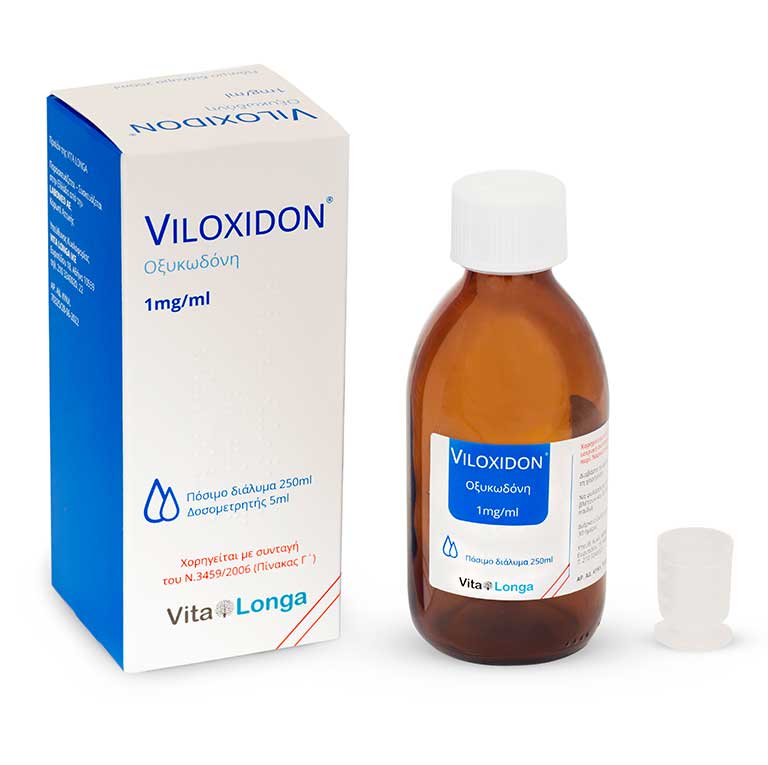
VILOXIDON® ORAL.SOL 1MG/ML
BTx 1 BOTTLE (GLASS - TYPE AMB 28 III) x 250ML + GRADUATED DOSING DEVICE 5 ML
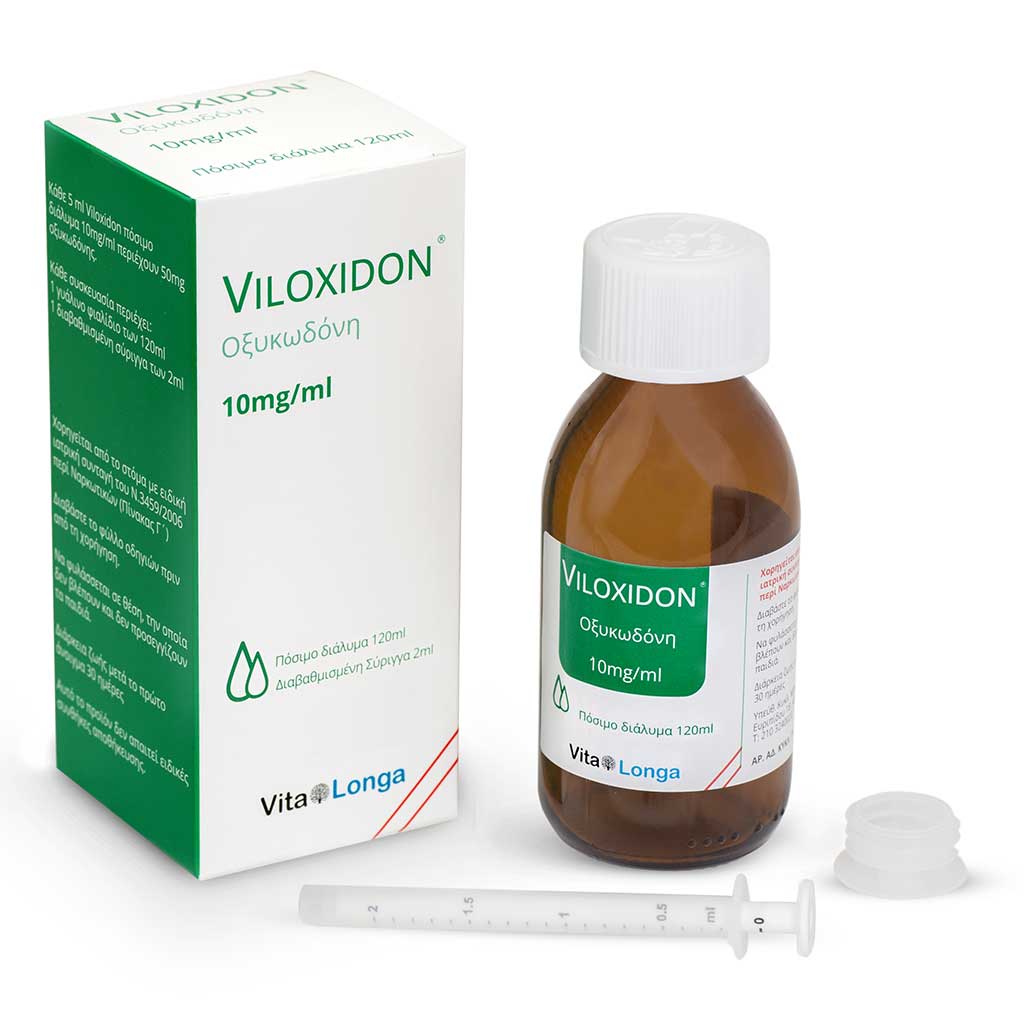
VILOXIDON® ORAL.SOL 10MG/ML
BTx 1 BOTTLE (GLASS - TYPE AMB 28 III) x 120ML + GRADUATED SYRINGE 2 ML
General
Viloxidon® contains as its active substance oxycodone, which belongs to the class of natural opium alkaloids. It is a semi-synthetic opium alkaloid that acts as a potent agonist of the μ opioid receptors in the brain, while it also interacts with the δ and κ opioid receptors in the brain, as well as with peripheral opioid receptors. Its action is analgesic, anxiolytic and sedative.
Indications
For the treatment of moderate to severe pain in patients with cancer or postoperative pain. For the treatment of severe pain requiring the administration of a strong opioid.
Posology and Method of Administration
Adults over 18 years of age:
Viloxidon® oral solution should be administered every 4-6 hours. The dose is individualised according to the severity of pain, the patient’s general condition and previous or concurrent analgesic treatment
Increasing pain intensity is managed with an increased dose of Viloxidon® oral solution. The correct dose for each patient is the one that ensures adequate analgesia and is well tolerated. Patients should be titrated to adequate analgesia unless uncontrolled adverse effects of the medicine prevent this.
The usual starting dose for patients who have not previously received opioids or patients with severe pain that is not managed by mild opioids is 5 ml (5 mg), every 4 – 6 hours. The dose should be adjusted daily if necessary, in order to achieve analgesia. For the majority of patients a daily dose greater than 400 ml (400 mg) is not required. However, some may need a higher dose.
Conversion from oral morphine:
Patients who were receiving oral morphine before oxycodone treatment should adjust their daily dose according to the ratio: 10 ml (10mg) of oral oxycodone is equivalent to 20 ml (20mg) of oral morphine. We point out that this is a guide for determining the dose of Viloxidon® oral solution. Because of the variability that occurs between patients, careful titration must be carried out for each patient in order to achieve the appropriate dose.
Elderly patients:
Dose adjustment is usually not required in elderly patients. Controlled pharmacokinetic studies in elderly patients (over 65 years of age) have shown that, compared with younger adults, the clearance of oxycodone is minimally reduced. No adverse reaction attributable to age has been observed, which is why the dosage and dosing intervals stated for adults are considered appropriate for elderly patients as well.
Patients with renal or hepatic impairment:
Plasma concentration in this group of patients may be increased. The starting dose should follow a conservative approach. The recommended starting dose for adults must be reduced by 50% [for example a total daily dose of 10 ml (10 mg), orally for patients receiving opioids for the first time], and each patient must be titrated to adequate analgesia according to their clinical condition.
Paediatric population:
Viloxidon® oral solution should not be given to patients under 18 years of age.
Use for pain caused by benign lesions
Opioids are not first-line treatment for chronic benign pain, nor are they recommended as the sole treatment. Various types of chronic pain that have been shown to respond to strong opioids include chronic osteoarthritic pain and intervertebral disc disease. The need for continued treatment in these cases must be assessed at regular intervals.
Method of Administration
Viloxidon® oral solution is administered orally.
Duration of Treatment
Oxycodone should not be used for longer than necessary. As with other strong opioids, the need for continued administration should be assessed at regular intervals.
Discontinuation of treatment
When a patient no longer requires treatment with oxycodone, it is recommended that the dose be reduced gradually in order to avoid withdrawal symptoms.
Undesirable Effects
The undesirable effects of the medicine are those typical of pure opioid agonists. Symptoms of tolerance and dependence may be observed (see section 4.4). Constipation can be prevented with an appropriate laxative. If nausea and vomiting are troublesome, oxycodone may be combined with an antiemetic.
Adverse reactions are classified by frequency:
Term Frequency Very common Common Uncommon Rare
Very rare
Not known
≥ 1/10 ≥ 1/100 to <1/10
≥ 1/1,000 to <1/100
≥ 1/10,000 to <1/1,000
< 1/10,000
Frequency cannot be estimated from the available data
Immune system disorders:
Uncommon: hypersensitivity.
Not known: anaphylactoid reaction, anaphylactic reaction.
Metabolism and nutrition disorders:
Common: decreased appetite. Uncommon: dehydration.
Psychiatric disorders:
Common: anxiety, confusional state, depression, insomnia, nervousness, abnormal thinking, abnormal dreams.
Uncommon: agitation, feeling unsteady, euphoria, hallucinations, decreased libido, drug dependence (see section 4.4), disorientation, mood swings, restlessness, dysphoria.
Not known: aggression.
Nervous system disorders:
Very common: somnolence, dizziness, headache. Common: tremor, lethargy, narcosis.
Uncommon: amnesia, convulsions, hypertension, hypoaesthesia, involuntary muscle contractions, speech disorder, syncope, paraesthesia, dysgeusia, hypotonia.
Not known: hyperalgesia.
Eye disorders:
Uncommon: visual impairment, miosis.
Ear and labyrinth disorders:
Uncommon: vertigo.
Cardiac disorders:
Uncommon: palpitations (in the context of withdrawal syndrome), supraventricular tachycardia.
Vascular disorders:
Uncommon: vasodilatation, facial rashes. Rare: hypotension, orthostatic hypotension.
Respiratory, thoracic and mediastinal disorders:
Common: dyspnoea, bronchospasm
Uncommon: respiratory depression, hiccups.
Gastrointestinal disorders:
Very common: constipation, nausea, vomiting.
Common: abdominal pain, diarrhoea, dry mouth, dyspepsia.
Uncommon: dysphagia, flatulence, eructation, ileus, gastritis. Not known: dental caries.
Hepatobiliary disorders:
Uncommon: increased liver enzymes, cholestasis, biliary colic.
Not known: Sphincter of Oddi dysfunction
Skin and subcutaneous tissue disorders:
Very common: pruritus.
Common: rash, hyperhidrosis.
Uncommon: dry skin, exfoliative dermatitis. Rare: urticaria.
Renal and urinary disorders:
Uncommon: urinary retention, urethral spasm.
Reproductive system and breast disorders:
Uncommon: erectile dysfunction, hypogonadism. Not known: amenorrhoea.
General disorders and administration site conditions:
Common: asthenic conditions, fatigue.
Uncommon: withdrawal syndrome, malaise, oedema, peripheral oedema, drug tolerance, thirst, pyrexia, chills.
Not known: neonatal withdrawal syndrome.
SmPC
Find the full SmPC of Viloxidon® here
Additional Links
Warning:
The above information is provided for informational or educational purposes. The initiation, continuation and discontinuation of treatment with Viloxidon® should be done strictly and only under the direction of a physician.
The links provided on this website that lead to external websites of international organisations, regulatory authorities and other bodies are for informational purposes only.
Vita Longa does not maintain any commercial, financial or other cooperation with the specific organisations, unless expressly stated. Reference or referral to them does not imply endorsement, sponsorship or recommendation of the views, information or services provided on the respective websites.
Vita Longa is not responsible for the content, accuracy or updating of the information hosted on external websites.


