
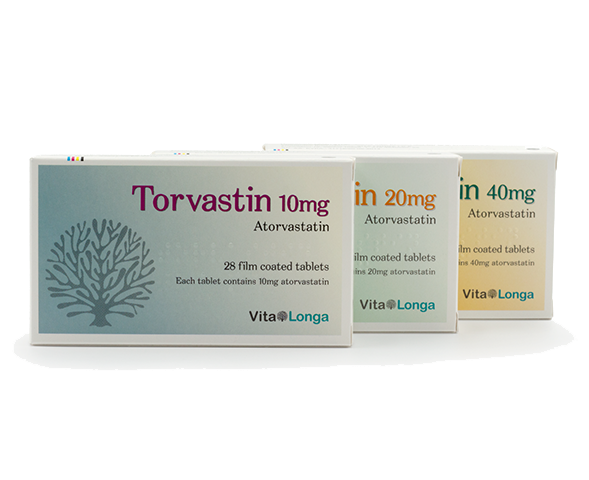
Torvastin®
Atorvastatin tablets 10mg, 20mg & 40mg
TORVASTIN F.C.TAB 10MG/TAB BTx28 (4 BLIST x7)
TORVASTIN F.C.TAB 20MG/TAB BTx28 (4 BLIST x7)
TORVASTIN F.C.TAB 40MG/TAB BTx28 (4 BLIST x7)
General
Torvastin® belongs to the group of medicines known as statins, which lower elevated blood lipids.
Torvastin® has as its active substance atorvastatin. It is used to reduce blood lipids, known as cholesterol and triglycerides, when a low-fat diet and lifestyle changes have failed.
Indications
Atorvastatin is indicated as an adjunct to diet to reduce elevated levels of total cholesterol, LDL–cholesterol, apolipoprotein B and triglycerides in patients with primary hypercholesterolaemia, including heterozygous familial hypercholesterolaemia and combined (mixed) hyperlipidaemia (Fredrickson types IIa and IIb), when diet and other non-pharmacological measures are inadequate. Atorvastatin is also indicated to reduce total cholesterol and LDL–cholesterol in patients with homozygous familial hypercholesterolaemia as an adjunct to other lipid-lowering treatments (e.g. LDL apheresis) or if such treatments are not available.
Posology and Method of Administration
Before taking atorvastatin, the patient should follow a standard lipid-lowering diet, which he or she should continue throughout treatment with atorvastatin.
The dose should be individualised based on baseline LDL–cholesterol levels, the goal of therapy and the patient’s response. The usual starting dose is 10mg once a day. Dose adjustment should be made at intervals of 4 weeks or more. The maximum dose is 80mg once a day.
Each daily dose of atorvastatin must be given as a single dose and may be taken at any time of the day, with or without food.
In patients with confirmed coronary heart disease or other patients at increased risk of ischaemic events, the goal of therapy is to achieve LDL–cholesterol levels <3mmol/L (or <115mg/dL) and total cholesterol <5mmol/L (or <190mg/dL).
[Adapted from the article: “Prevention of coronary heart disease in clinical practice: Recommendations of the Second Joint Task Force of European and Other Societies on Coronary Prevention” of the journal Atherosclerosis 140 (1998) 199–270].
Primary hypercholesterolaemia and combined (mixed) hyperlipidaemia:
The majority of patients are controlled with 10mg of atorvastatin once daily. Treatment results are seen within 2 weeks, while the maximum therapeutic response is usually achieved within 4 weeks and is maintained as long as the patient takes the medicine.
Heterozygous familial hypercholesterolaemia:
Treatment starts with 10mg of atorvastatin daily. Doses should be individualised and adjusted every 4 weeks up to 40mg daily. Thereafter, either the dose is increased to a maximum of 80mg daily or 40mg of atorvastatin is given once a day in combination with an ion exchange resin.
Homozygous familial hypercholesterolaemia:
In a compassionate use study in 64 patients, information was available for 46 patients in whom the presence of LDL receptors had been confirmed. In these 46 patients, the mean reduction in LDL– cholesterol was approximately 21%. Atorvastatin was given at doses of up to 80mg daily.
The dose of atorvastatin in patients with homozygous familial hypercholesterolaemia is 10 to 80mg daily. Atorvastatin should be given to these patients as an adjunct to other lipid-lowering treatments (e.g. LDL apheresis) or if such treatments are not available.
Dosage in patients with renal impairment:
Renal impairment does not affect plasma concentrations of atorvastatin or its effect on lipids, therefore no dose adjustment is needed.
Administration in the elderly:
The efficacy and safety of the medicine in patients older than 70 years, when the recommended doses are used, are similar to those observed in the general population.
Administration in children:
Paediatric use should be recommended only by specialists. Experience in children is limited to a small number of patients (aged 4–17 years) with severe dyslipidaemias, such as homozygous familial hypercholesterolaemia. The recommended starting dose in this population is 10mg of atorvastatin daily. The dose may be increased up to 80mg daily, according to the patient’s response and tolerability. Safety data regarding development in this patient population have not been evaluated.
Undesirable Effects
The most commonly expected undesirable effects are mainly gastrointestinal and include constipation, flatulence, dyspepsia, abdominal pain, and usually resolve with continuation of treatment.
Less than 2% of patients discontinued their participation in the clinical studies of the medicine because of adverse reactions attributed to atorvastatin.
Based on data from clinical studies and the considerable experience gained since the medicine was placed on the market, the table below presents the adverse reactions that occurred with atorvastatin.
Adverse reactions are classified according to their frequency of occurrence as:
Common (>1/100, <1/10), uncommon (>1/1,000, <1/100), rare (>1/10,000, < 1/1,000), very rare (<1/1,000).
Gastrointestinal disorders:
Common: constipation, flatulence, dyspepsia, nausea, diarrhoea.
Uncommon: anorexia, vomiting.
Blood and lymphatic system disorders:
Uncommon: thrombocytopenia.
Immune system disorders:
Common: allergic reactions.
Very rare: anaphylactic reactions.
Endocrine disorders:
Uncommon: alopecia, hyperglycaemia, hypoglycaemia, pancreatitis.
Psychiatric:
Common: insomnia.
Uncommon: amnesia.
Central nervous system disorders:
Common: headache, dizziness, paraesthesia, hypoaesthesia.
Uncommon: peripheral neuropathy.
Hepatobiliary disorders:
Rare: hepatitis, cholestatic jaundice.
Skin/Skin appendages:
Common: skin rash, pruritus.
Uncommon: urticaria.
Very rare: angioedema, bullous rashes (including erythema multiforme, Stevens–Johnson syndrome and toxic epidermal necrolysis).
Ear and labyrinth disorders:
Uncommon: tinnitus
Musculoskeletal disorders:
Common: myalgia, arthralgia.
Uncommon: myopathy.
Rare: myositis, rhabdomyolysis.
Reproductive system disorders:
Uncommon: impotence.
General disorders:
Common: asthenia, chest pain, back pain, peripheral oedema.
Uncommon: malaise, weight gain.
Investigations:
Increased transaminase levels were observed in patients taking atorvastatin, which also occurs with other HMG–CoA reductase inhibitors. This increase was usually small, transient, and did not require discontinuation of treatment. In patients taking atorvastatin, a clinically significant increase in serum transaminases (more than three times the upper normal limit) was observed in 0.8%. This increase was dose-dependent and was reversible in all patients.
CPK levels greater than 3 times the upper normal limit were observed in 2.5% of patients receiving atorvastatin, a rate similar to that observed in clinical studies with other HMG–CoA reductase inhibitors. Levels 10 times above the upper normal limit were observed in 0.4% of patients treated with atorvastatin (see 4.4. Special warnings and precautions for use, effects on skeletal muscle).
SmPC
Find the full SmPC of Torvastin® here
Warning:
The above information is provided for informational or educational purposes. The initiation, continuation and discontinuation of treatment with Torvastin® should be done strictly and only under the direction of a physician.
The links provided on this website that lead to external websites of international organisations, regulatory authorities and other bodies are for informational purposes only.
Vita Longa does not maintain any commercial, financial or other cooperation with the specific organisations, unless expressly stated. Reference or referral to them does not imply endorsement, sponsorship or recommendation of the views, information or services provided on the respective websites.
Vita Longa is not responsible for the content, accuracy or updating of the information hosted on external websites.


